Technical SEO in Singapore Is a Regional Problem, Not a Local One
Technical SEO for Singapore websites that serve more than one market or language. Hreflang, geo-redirects, Googlebot and the outdated advice to drop.
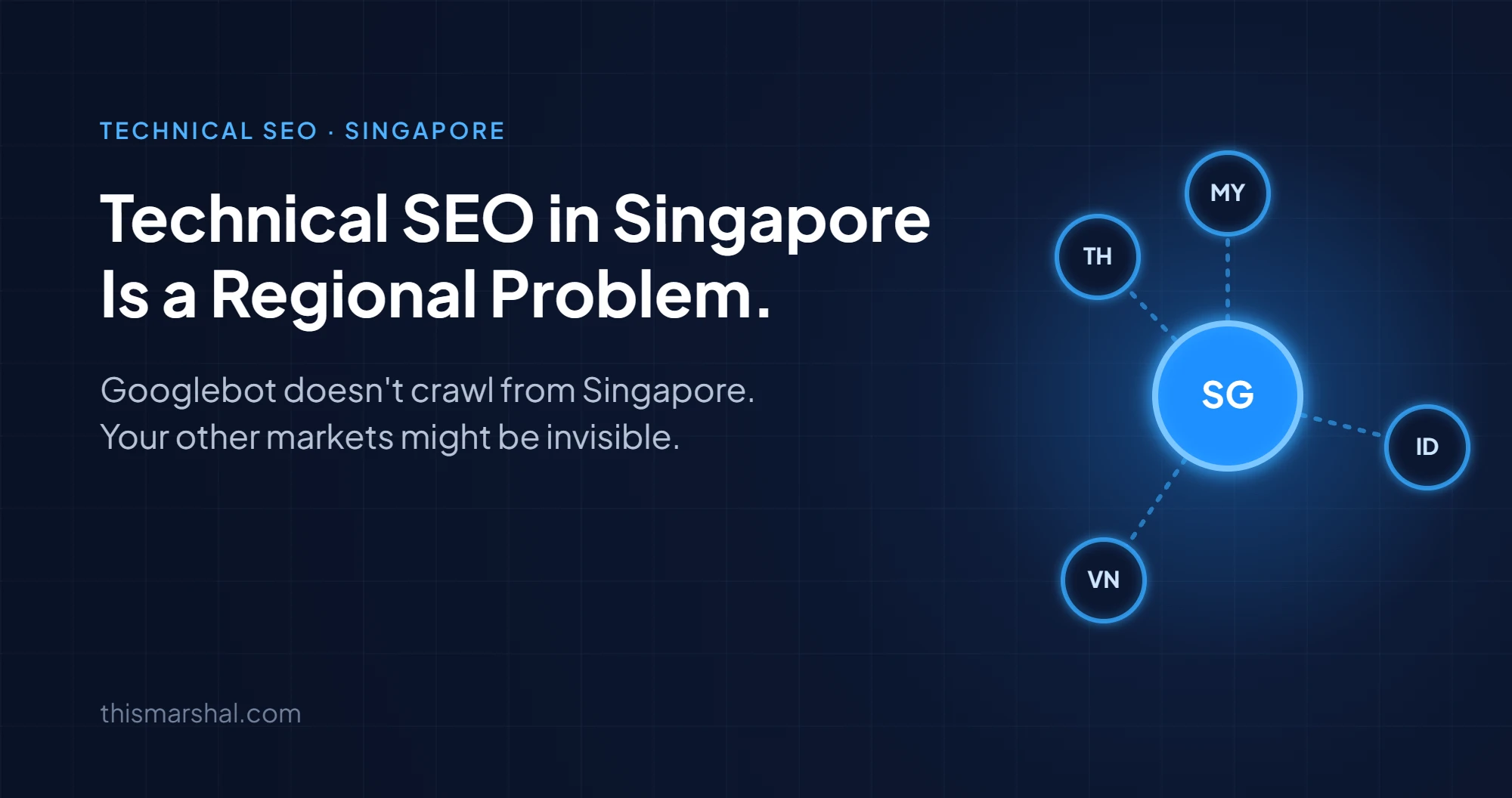
Technical SEO is the work of making sure search engines can crawl, render, index and serve your website correctly. For a Singapore business, there’s an extra layer most guides skip: which market and which language Google thinks each page is for. Here’s the uncomfortable part. Googlebot usually doesn’t visit your Singapore website from Singapore. Google says its crawler typically originates from the US and sends requests without an Accept-Language header.
That one detail breaks a lot of Singapore sites. Plenty of businesses here serve Singapore, Malaysia, Indonesia and the wider region from one domain, often in more than one language. If your site redirects visitors by IP or browser language, Google may only ever see one version of it. Your other markets don’t rank because, as far as Googlebot can tell, they barely exist.
So technical SEO in Singapore is rarely a local problem. It’s a regional one.
What Technical SEO Covers for a Singapore Website
The fundamentals are the same everywhere:
-
Crawlability. Googlebot can reach your important URLs, with nothing in robots.txt, your CDN or your firewall blocking it.
-
Rendering. Key content exists in the HTML Google renders, not only after JavaScript runs in the browser.
-
Indexability. Pages return a 200, carry no accidental noindex, and point to the right canonical.
-
Page experience. Real visitors get fast, stable pages on mobile.
Singapore sites add a fifth technical SEO job:
- Market and language signals. Each regional or language version has its own URL, its own content, and annotations that tell Google which audience it serves.
Get the first four technical SEO jobs wrong and nothing ranks. Get the fifth wrong and the wrong version ranks, or only one version ranks at all.
Where Technical SEO in Singapore Usually Breaks
Geo-IP and language redirects hide your other markets
Auto-redirecting visitors to /my/ or /id/ based on IP feels user friendly. To Googlebot, crawling from the US with no language preference, it often means landing on the same default version every time.
Fix it this way: give every market and language its own crawlable URL, link them to each other, and suggest a switch with a banner instead of forcing a redirect. Google recommends separate URLs for each language version and advises against using cookies or browser settings to swap the content on one URL.
Hreflang that Google quietly ignores
Hreflang tells Google which URL to show to which language and region. It only works when it’s exact:
-
Return links are mandatory. If page A points to page B, page B has to point back. Google says that if two pages don’t both point to each other, the tags are ignored.
-
Each page lists itself. Every version includes a self-referencing hreflang tag alongside the others.
-
Language comes first. “en-SG” is valid. “SG” on its own isn’t, because Google doesn’t accept a country code without a language.
-
Chinese needs care. “zh-SG” works, and Google derives the script from the region. If you serve both Simplified and Traditional Chinese, use script codes like “zh-Hans” and “zh-Hant”.
-
Use x-default for the fallback. Point it at a language selector or your main international page for users who don’t match any version.
Four official languages, one URL each
Singapore has four official languages: English, Malay, Mandarin and Tamil. If you publish in more than one, each language needs its own URL. Two technical details matter here:
-
Google determines a page’s language from its visible content. It doesn’t use the HTML lang attribute or the URL for that.
-
Mixing languages on one page, like a Mandarin page with English navigation and English body copy, makes that signal muddy.
Near-identical English versions for SG, MY and the region
A lot of regional sites run English pages for Singapore and Malaysia that are 95% the same. Google may treat them as duplicates and pick one canonical. Hreflang helps Google show the right regional URL, but you also need a reason for each version to exist. Localise prices and currency, delivery terms, contact details and examples. If the pages are genuinely identical, ask whether you need both.
.sg, .com.sg or a .com with subfolders?
-
.sg or .com.sg. A country-code domain is a strong signal that the site targets Singapore. Great for a Singapore-only business, limiting for a regional one.
-
.com with subfolders (/sg/, /my/, /id/). Easier to manage on one host and one authority base. Relies on hreflang and local content to separate markets.
-
Separate ccTLDs per country. The clearest country signal, but more infrastructure and links to build for each domain.
There’s no universally right answer. Pick based on where you sell, not on what a competitor did.
How to Choose the Best Technical SEO Services in Singapore
What the best technical SEO services deliver, what an audit should include, and 8 questions to ask before you hire one in Singapore.
Outdated Technical SEO Advice Still Ranking in Singapore
I went through the technical SEO guides currently ranking for Singapore. Several still recommend things Google has retired:
-
First Input Delay targets. INP replaced FID as a Core Web Vital in March 2024.
-
The Mobile-Friendly Test. Google retired it, along with the Search Console Mobile Usability report, in December 2023.
-
Search Console country targeting. Google removed the International Targeting report in September 2022. Hreflang is still supported.
-
rel=“next” and rel=“prev” for pagination. Google stopped using them for indexing years ago. Make paginated pages crawlable with normal links instead.
-
FAQ and HowTo markup for rich results. Google retired HowTo rich results in 2023 and stopped showing FAQ rich results in May 2026. The markup won’t hurt, but it won’t win you a rich result.
-
“Host in Singapore to rank in Singapore.” Google treats server location as a weak hint, not a definitive signal. Local hosting or a CDN with Singapore edge locations helps speed, which is a good reason on its own.
If your agency’s technical SEO audit still includes these, it’s a template, not a diagnosis.
The Technical SEO Basics Still Decide Everything
Regional signals sit on top of the technical SEO basics. Check these first:
-
Crawl and index. Use URL Inspection and the Page indexing report in Search Console for your top revenue pages in every market.
-
Rendering. Compare raw and rendered HTML on JavaScript-heavy pages, especially headless or React builds.
-
Core Web Vitals. Google assesses them at the 75th percentile of real visits:
| Metric | Measures | Good |
|---|---|---|
| LCP (Largest Contentful Paint) | Loading | 2.5 seconds or less |
| INP (Interaction to Next Paint) | Responsiveness | 200 ms or less |
| CLS (Cumulative Layout Shift) | Visual stability | 0.1 or less |
- Structured data. Mark up what users can see, and validate templates. Ecommerce stores often stack duplicate markup from themes and apps, which is how a review app duplicates your Shopify product schema.
A Technical SEO Check for Singapore Multi-Market Sites
Run this before you pay for a full technical SEO audit:
-
Open your site in a private window with a VPN set to the US. Can you reach every market version without being redirected?
-
Inspect one URL per market in URL Inspection. Is each version indexed, and is it its own canonical?
-
View the source of one page per market. Does every hreflang set include a self-reference and return links?
-
Check hreflang codes. Language first, valid region codes, scripts for Chinese where needed.
-
Confirm each language page is actually written in that language, navigation included.
-
Check the Core Web Vitals report for mobile URLs marked “Poor”.
-
Remove FID targets, Mobile-Friendly Test steps and rel=“next”/“prev” from your audit template.
If the list turns up more than your team can handle, that’s the kind of work I take on: technical SEO audits for multi-market sites, plus hands-on fixes in the codebase. You can see past projects at thismarshal.com.
Frequently Asked Questions
What is technical SEO?
Technical SEO is the process of making sure search engines can crawl, render, index and serve your website. It covers robots.txt, rendering, canonical tags, site speed, Core Web Vitals, structured data and, for multi-market sites, hreflang.
Do I need a .sg domain to rank in Singapore?
No, but it helps for a Singapore-only business. A .sg or .com.sg domain is a strong country signal. A .com can rank in Singapore with a /sg/ section, local content and correct hreflang.
What hreflang code should a Singapore page use?
Use “en-SG” for English pages aimed at Singapore. Use “zh-SG”, “ms-SG” or “ta-SG” for Mandarin, Malay or Tamil versions. Never use “SG” on its own, and make sure every version links back to the others.
Should I redirect visitors based on their location?
Avoid forced redirects. Googlebot usually crawls from the US without a language preference, so it may never see your other versions. Use separate URLs, hreflang and an optional banner that suggests the right version.
Does hosting in Singapore improve Google rankings?
Not as a geotargeting signal on its own. Google treats server location as a weak hint. Hosting locally or using a CDN with Singapore edge locations mainly helps by cutting load times for Singapore visitors.

Marshal Gasong
Digital Marketing Specialist and Web Developer with 8 years of experience in SEO, technical audits, and full-stack development. Helped businesses rank on page 1, shipped SaaS products used by thousands, and driven real revenue through search. Currently available for freelance work and open to full-time opportunities.