What Makes Content SEO-Friendly in 2026
Learn what SEO-friendly content means in 2026, from crawlability and on-page optimization to LLM citations, GEO, and AI Overviews.
SEO-friendly has always meant making your content readable to search engines, not just people. A page can look great visually but still be completely invisible to Google if it is not structured correctly. That core idea has not changed. What has changed is that there is now a second type of machine you need to write for: large language models.
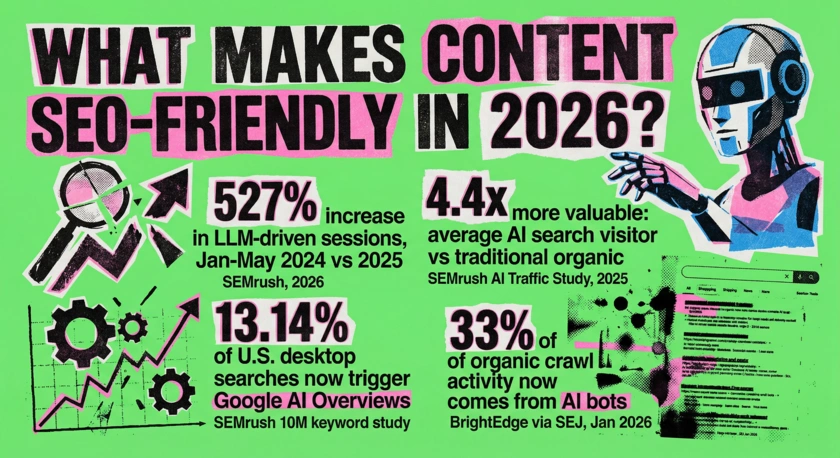
Tools like ChatGPT, Perplexity, and Google AI Overviews are increasingly where people get answers. SEMrush tracked a 527% increase in LLM-driven website sessions between early 2024 and the same period in 2025. And according to Search Engine Journal, AI bots like GPTBot, ClaudeBot, and PerplexityBot now account for roughly 33% of all organic crawl activity. That shift changes how you need to think about content.
4.4X
more valuable: average AI search visitor vs. traditional organic visitor
527%
increase in LLM-driven website sessions, Jan-May 2024 vs same period 2025
13.14%
of U.S. desktop searches now trigger Google AI Overviews (as of March 2025).
33%
of organic search activity now comes from AI bots (GPTBot, ClaudeBot, PerplexityBot)
The Fundamentals That Still Matter
Indexable content
HTML text is still the safest bet. Anything you want crawled should live as readable text in the page source, not buried in JavaScript renders or iframes. For non-text content, use alt text on images, add transcripts to videos, and make sure every page is reachable through internal links. SEMrush specifically flags client-side JavaScript as a problem for LLM crawlers, which cannot render dynamic content the way a browser does.
Link architecture
Crawlers, whether Google’s or an AI bot’s, discover pages by following links. Broken navigation, orphaned pages, and long redirect chains all hurt crawl efficiency. The stakes are actually higher with AI search because these tools surface one answer, not ten results. If a bot cannot reach your page at all, there is no fallback position.
Keywords and semantic SEO
Keyword strategy has shifted toward topic coverage rather than repetition. Using your primary keyword alongside related terms and synonyms that match how people actually search performs better in both Google and AI-generated answers. Stuffing a phrase into a page over and over does not help anymore and in some cases actively signals low quality.
On-page basics
-
Primary keyword in the title tag, ideally within the first 60 characters.
-
Keyword mentioned naturally within the first 100 words of the body.
-
Keyword variations spread through the middle sections.
-
Short, descriptive URL slug that includes the keyword.
-
Meta description that gives users a real reason to click.
-
Clear H1, H2, H3 structure that both users and crawlers can navigate.
GEO, AEO, and LLMO: What They Actually Mean
These three terms get thrown around a lot right now. Here is the practical difference between them.
SEO is still about ranking on Google and Bing through technical health, content relevance, and backlinks. Nothing new there. AEO (Answer Engine Optimization) focuses on being the direct answer in featured snippets, voice search, and AI-enhanced results. GEO and LLMO (Generative Engine Optimization and LLM Optimization) are essentially the same thing: getting your content cited by language models when they generate answers.
As Ahrefs’ Bernard Huang put it at Ahrefs Evolve, LLMs are the first realistic search alternative to Google. That is not hyperbole at this point. And as Search Engine Journal noted in January 2026, technical SEO is what makes content machine-readable for all of these systems. Without solid fundamentals, GEO and AEO efforts have nothing reliable to work with.

Your Review App Just Duplicated Your Shopify Product Schema
Your theme adds Product schema. Your review app adds more. Your SEO app adds a third. Here's how to find and fix duplicate schema before it costs you rich results.
Making Your Content LLM-Friendly
Put the answer first
LLMs pull from the opening of your content disproportionately. SEMrush recommends front-loading your core answer as the first sentence of every section, rather than building up to it with context. This is a real shift from traditional long-form writing, where you would typically set the scene before delivering the point. For AI-optimized content, the point comes first.
Write in self-contained sections
Each H2 or H3 section should make sense on its own without requiring the reader to have read what came before. SEMrush describes this as treating each section like a standalone answer. If a section only makes sense in context of the previous one, it is worth restructuring.
E-E-A-T is now a citation signal
Google’s E-E-A-T framework (Experience, Expertise, Authoritativeness, Trustworthiness) was built for quality raters, but it now maps closely to how LLMs decide which sources to cite. Anonymous content or generic author bylines reduce your chances of being referenced. A named author with real credentials, links to professional profiles, and original data or first-hand experience consistently performs better in AI-generated answers. SEMrush found that consistent, abundant brand information across the web improves LLM citation likelihood.
Schema markup
Structured data has always helped Google understand your pages. For LLMs it serves the same function: giving the crawler machine-readable context about what your page is, who wrote it, and what it covers. SEMrush’s Site Audit now includes a dedicated AI Search audit category that covers schema and llms.txt, an emerging standard that works like robots.txt but specifically for LLM crawlers.
Keep content fresh
AI tools tend to surface recently published or updated content over older pages that have not been touched in years. If you have pages that ranked well previously but are starting to lose ground, refreshing the content with updated data and current references is often more effective than building new pages from scratch. Use Google Analytics 4 to identify where traffic is declining and start there.
Where to Start
You do not need to overhaul everything at once. Pick one high-intent page, make sure the answer is in the first paragraph, check that the schema is complete, and confirm the page is accessible to crawlers with no JavaScript blocks. That is a solid starting point. The brands that are doing well in AI search right now, as Search Engine Journal noted, are mostly the ones that already invested in strong foundational SEO. The gap between having it and not having it is widening.

Marshal Gasong
Digital Marketing Specialist and Web Developer with 8 years of experience in SEO, technical audits, and full-stack development. Helped businesses rank on page 1, shipped SaaS products used by thousands, and driven real revenue through search. Currently available for freelance work and open to full-time opportunities.