Why Digital Marketing is Non-Negotiable for Your Business in 2026
Here is a simple question worth asking: is your business actually findable online? Not just having a social media account that gets updated occasionally, but genuinely visible in the places where your potential customers are actively looking every single day. If the answer is not a confident yes, this article is worth reading in full.
Digital marketing is no longer an optional add-on to your core business strategy. It is the foundation of how modern businesses operate, communicate with customers, and grow sustainably. Television, radio, billboards, and print ads still exist, but they are no longer the most effective way to reach people. Consumers have moved online, and businesses that have not followed them are already falling behind.
How a Pandemic Permanently Shifted the Way Business Works
If there was one moment that accelerated the shift to digital faster than anything before it, that moment was COVID-19. The impact was global and immediate, but the way it played out varied by region in ways that are worth understanding.
In the United States, lockdowns pushed consumers toward online shopping at a pace no one had predicted. Curbside pickup became standard overnight. Small businesses that had never touched e-commerce were suddenly building Shopify stores and running Facebook ads just to stay afloat. Amazon saw demand it could not keep up with. Local restaurants pivoted to delivery-only models within weeks.
In Australia, the story was similar. When Melbourne entered one of the world’s longest lockdowns, businesses that had relied entirely on foot traffic found themselves with no fallback. The ones that survived were largely those that moved fast digitally. Australian consumers who had previously preferred in-store shopping developed habits around online ordering and click-and-collect that have largely stuck around since.
Across Southeast Asia, including Indonesia, the shift was just as dramatic but even more mobile-driven. Platforms like Tokopedia, Shopee, and Lazada saw explosive growth as consumers who had never shopped online before were suddenly doing all their purchasing from a smartphone. Small and medium businesses that had operated entirely offline, from street food vendors to local suppliers, started selling through WhatsApp, social media, and marketplace apps practically overnight.
When restrictions lifted, consumer behavior did not fully revert in any of these markets. People who had grown comfortable buying online, comparing prices on their phones, and reading reviews before committing stayed that way. The pandemic compressed what might have been a decade of digital adoption into roughly two years, and the data since then reflects exactly that.
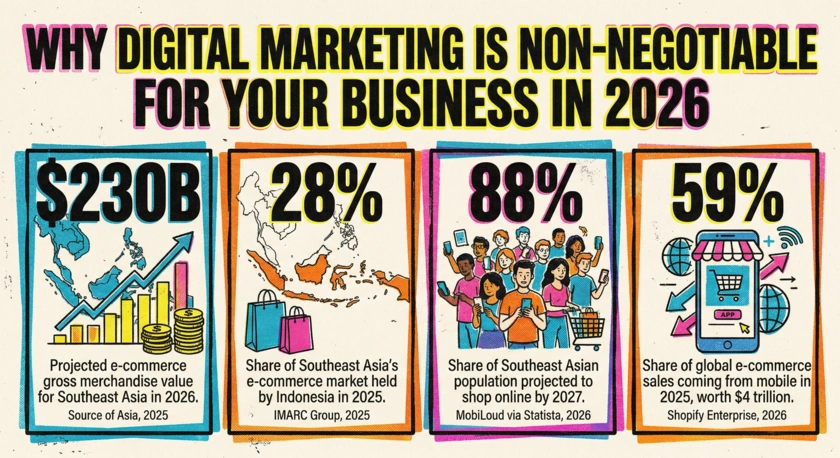
88%
Share of Southeast Asian population projected to shop online by 2027
59%
Share of global e-commerce sales coming from mobile in 2025, worth $4 trillion
These numbers are not just impressive statistics. They tell you that the digital market in this region is still wide open and growing fast. Businesses that establish a strong online presence now are building a competitive advantage that compounds over time.
Five Reasons Digital Marketing Matters for Your Business
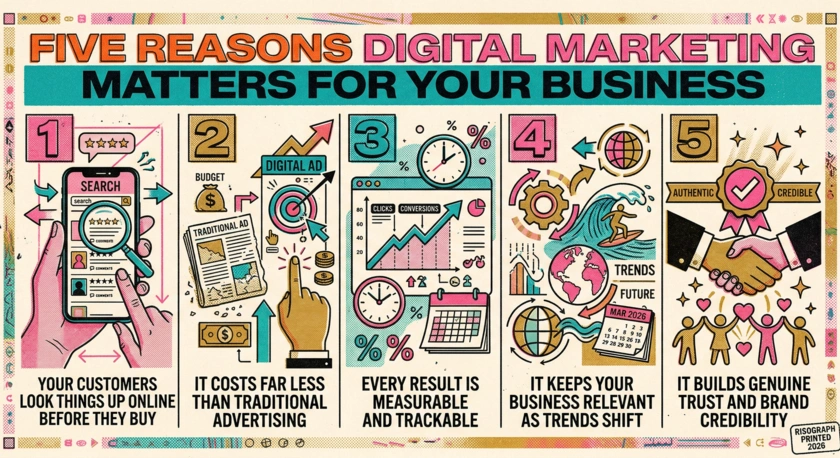
- Your customers look things up online before they buy
Before making a purchase decision, today’s consumers almost always search for information first. They type in a keyword, read reviews, compare options, and only commit once they feel confident. This behavior is not going away. It is deepening.
This is exactly where an SEO specialist becomes critical to your business growth. What does an SEO specialist do? In short, they make sure your business shows up in those search results at the moment a potential customer is actively looking for what you offer. Not just appearing somewhere on page three, but ranking high enough to actually get clicked. The reality is that the first page of Google captures over 90% of all search clicks. Everything beyond that barely gets seen.
If your business is not visible when people search for your product or service, you are quietly handing those customers to competitors who are better prepared digitally.
- It costs far less than traditional advertising
A single prime-time television slot in a major market can cost hundreds of millions of rupiah for one airing. A billboard on a busy street is not cheap either, and there is no reliable way to measure how many people actually paid attention to it. Digital marketing works on a fundamentally different and more efficient model.
A well-executed SEO strategy means content you create today can keep driving traffic and generating customers for months or years without any additional spend. Google Ads lets you set daily budgets that match your business capacity, and you only pay when someone actually clicks through to your site. That pay-per-click model is significantly more accountable than paying upfront with no guaranteed outcome.
For small businesses with tight budgets, digital marketing levels the playing field in a way that traditional advertising never could. It is also why freelance digital marketing has grown into such a viable career path, because businesses of all sizes now need these skills but do not always have the resources to hire full in-house teams.
- Every result is measurable and trackable
One of the biggest advantages digital marketing has over conventional methods is the precision of its measurement. With traditional advertising, estimating how many people saw your ad and how many of those actually bought something is mostly guesswork.
With digital marketing, everything is trackable. Google Analytics shows you how many visitors came to your website, where they came from, which pages they visited, how long they stayed, and whether they completed a purchase. Google Tag Manager and tracking pixels let you set up custom events for every meaningful action a visitor takes, from clicking a button to filling out a form to completing a transaction.
That data is not just useful for reporting. It is what allows you to make smarter decisions about where to allocate budget, which channels are actually converting, and where there are gaps in the customer journey worth fixing.
- It keeps your business relevant as trends shift
The digital world moves fast. Platforms that dominate today can look very different in a few years. Search engine algorithms update regularly. Consumer behavior evolves. Businesses that do not actively adapt to these shifts find their visibility and relevance eroding over time.
TikTok is a clear recent example. Businesses that recognized early how effective short-form video content was for reaching younger audiences captured significant market share while competitors were still debating whether to take it seriously. The same pattern is now playing out with AI-powered search. Google AI Overviews, ChatGPT Search, and Perplexity are changing how people discover information, and the businesses and content creators who adapt their strategies accordingly will have a meaningful advantage going forward.
- It builds genuine trust and brand credibility
Customers who find your business through organic search tend to arrive with a higher level of trust than those who click on a paid ad. When someone searches for a product or service and your business consistently appears at the top of results, there is an implicit signal that you are a credible and established option worth considering.
Active social media engagement, positive customer reviews, consistently useful content, all of these contribute to your digital reputation in ways that compound over time. A business with a strong, coherent digital presence simply feels more professional and trustworthy to someone encountering it for the first time. Interactive campaigns like giveaways, Q and A sessions, and user-generated content initiatives further strengthen the relationship with existing customers and keep your brand visible to their networks.
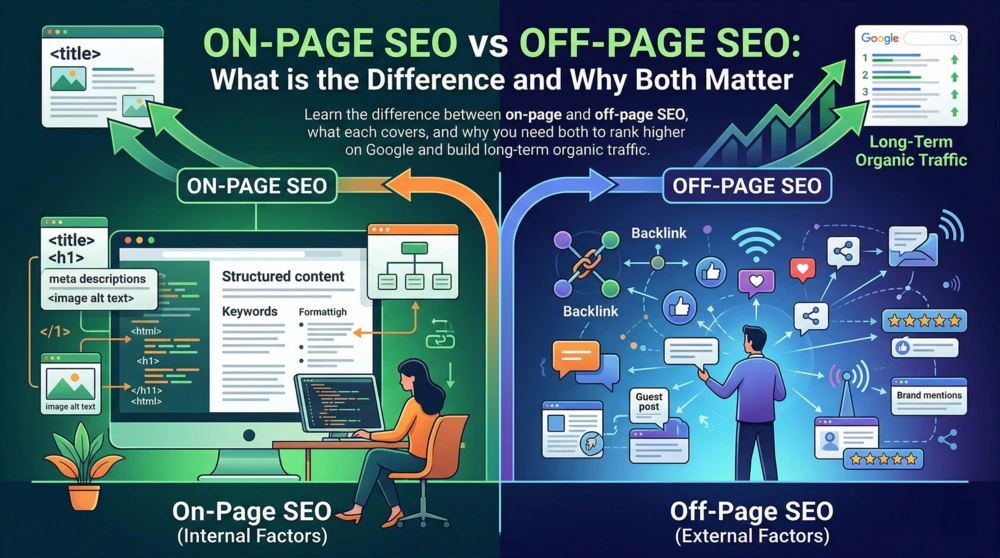
On-Page SEO vs Off-Page SEO: What is the Difference and Why Both Matter
Learn the difference between on-page and off-page SEO, what each covers, and why you need both to rank higher on Google and build long-term organic traffic.
Types of Digital Marketing Worth Knowing
Understanding the types of digital marketing available is the first step toward choosing the right mix for your business. The main channels include:
-
Search Engine Optimization (SEO) is the process of optimizing your website to appear at the top of organic search results. A technical SEO specialist focuses on the foundational elements like site speed, crawlability, structured data, and URL architecture. A local SEO specialist focuses on visibility in location-based searches, which is particularly valuable for service businesses targeting customers in a specific city or region. If you are running a business in Australia, working with an SEO specialist in Australia who understands the local search landscape and consumer behavior can make a significant difference.
-
Search Engine Marketing (SEM) covers paid advertising on search engines like Google Ads. Unlike SEO, which takes time to build momentum, SEM can drive targeted traffic immediately once a campaign is live.
-
Content Marketing involves creating and distributing genuinely useful content for your target audience, including blog articles, videos, infographics, and podcasts. Strong content supports SEO while building long-term brand authority.
-
Social Media Marketing covers all promotional activity on social platforms. In Southeast Asia, Instagram, TikTok, Facebook, and YouTube currently dominate, though the mix varies by industry and audience.
-
Email Marketing remains one of the highest-ROI channels available for nurturing relationships with existing customers and driving repeat purchases.
-
Affiliate and Influencer Marketing leverages other people’s networks and audiences to promote your products or services, typically through commission-based arrangements or paid partnerships.
How to Start Digital Marketing
For business owners, the starting point is making sure your digital foundation is solid. A fast, mobile-friendly website that is properly indexed by Google is the non-negotiable first step. From there, identify one or two channels that make the most sense for your specific audience and focus there before expanding further.
For individuals looking to build a career in this field, understanding the fundamentals of digital marketing is the right place to begin. SEO is a particularly strong entry point because the skills involved underpin almost every other effective digital marketing strategy. Many professionals in the industry started as an SEO specialist before expanding into paid media, content strategy, analytics, or broader digital marketing roles.
Freelance digital marketing has also grown significantly as a career model, especially for those who value flexibility. With a solid portfolio and demonstrable results, a freelance digital marketing specialist can work with clients across industries and geographies, including international clients in Australia, the US, or Europe, entirely remotely.
2026 Trends That Are Already Changing the Game
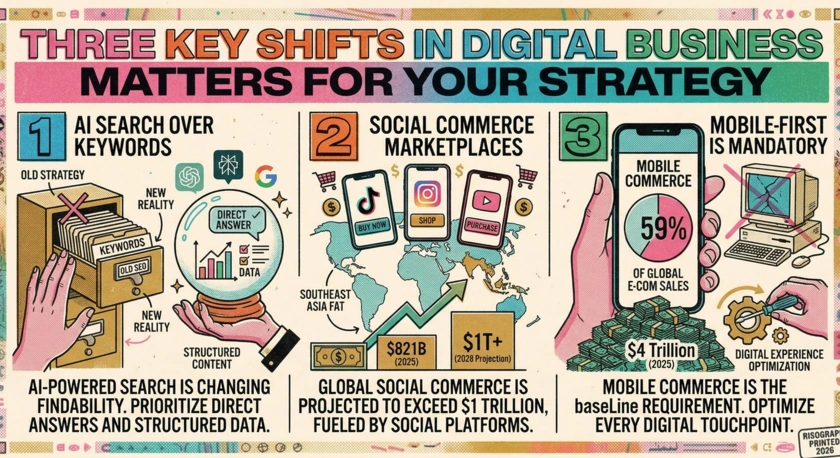
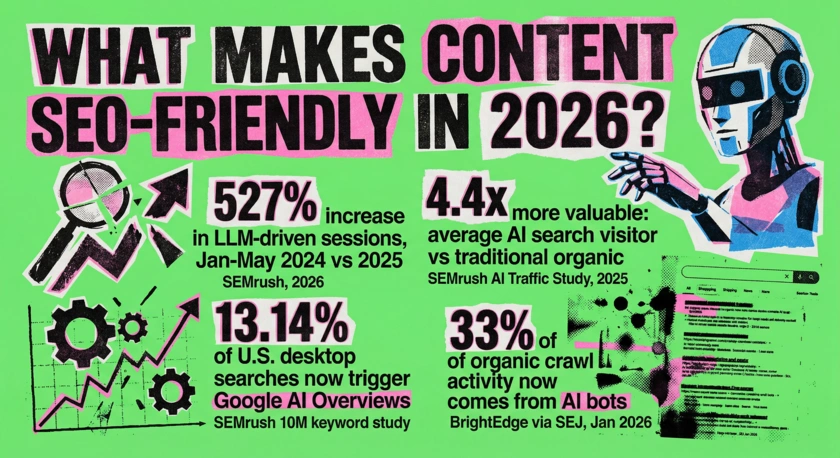
AI-powered search is the most significant shift happening right now. Google AI Overviews, ChatGPT Search, and Perplexity are already changing how people find information, and the strategies that worked three years ago are not enough on their own anymore. Content that is well-structured, answers questions directly, and is backed by credible data performs far better in this new environment than content built around keyword repetition alone.
Social commerce is accelerating rapidly as well. The global social commerce market reached $821 billion in 2025 and is projected to exceed $1 trillion by 2028, driven by TikTok, Instagram, and YouTube integrating direct purchasing into their platforms. In Southeast Asia, this trend is moving even faster given the extremely high smartphone and social media penetration among working-age populations.
Mobile-first is no longer a preference, it is a baseline requirement. With mobile commerce accounting for 59% of global e-commerce sales and $4 trillion in transactions in 2025, optimizing every aspect of the digital experience for smartphone users is simply part of doing business correctly.

Marshal Gasong
Digital Marketing Specialist and Web Developer with 8 years of experience in SEO, technical audits, and full-stack development. Helped businesses rank on page 1, shipped SaaS products used by thousands, and driven real revenue through search. Currently available for freelance work and open to full-time opportunities.